
AI-generated illustration; not a photograph of the reported event.
- calendar_today November 13, 2026
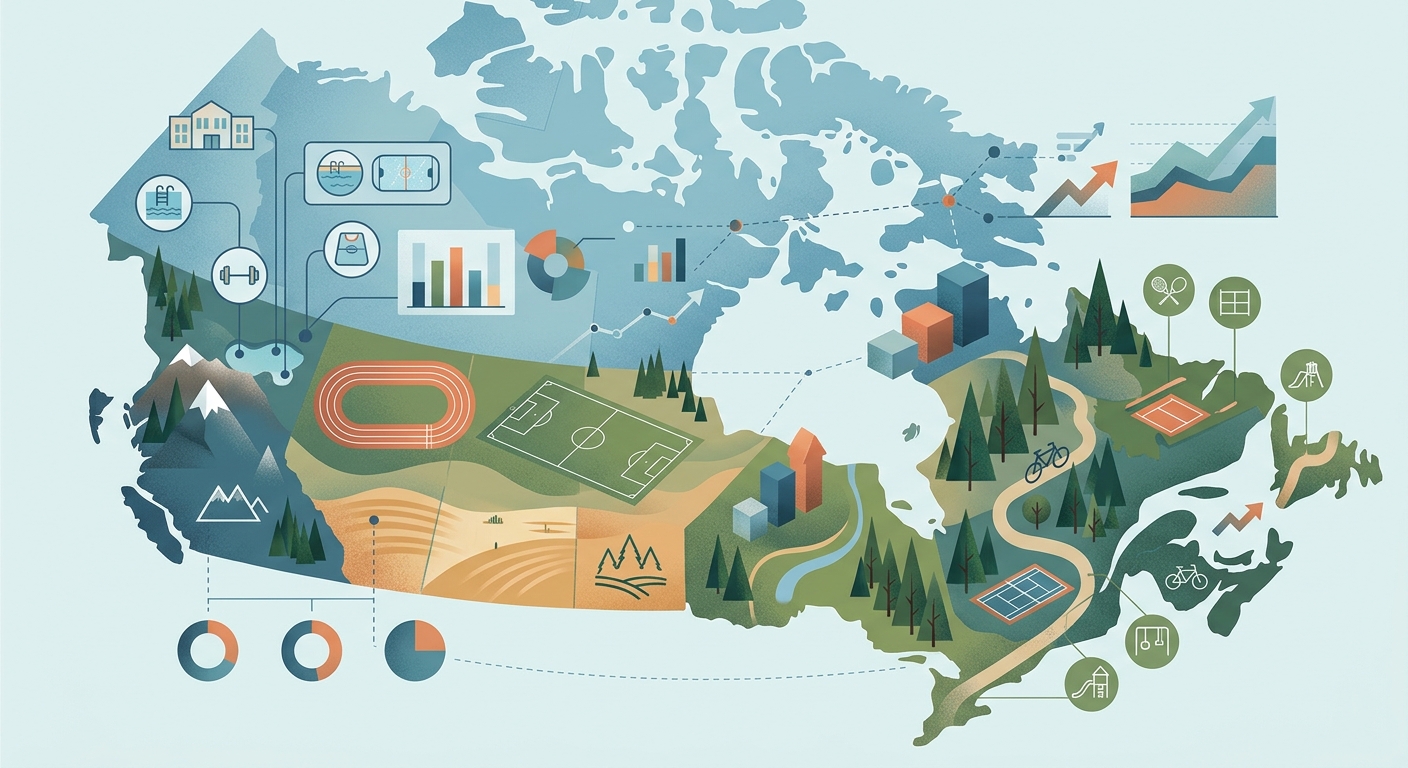
Canadians in every province regularly seek opportunities for recreation and physical activity, but how accessible are the nation's recreational and sports facilities? Recent open data initiatives have provided detailed insight into the distribution and classification of such facilities across Canada.
The Open Database of Recreational and Sport Facilities (ODRSF) is a comprehensive, harmonized dataset containing the names, types, and locations of recreational and sport facilities throughout Canada. This resource, part of the Linkable Open Data Environment (LODE), compiles data from provincial, territorial, and municipal governments, aiming to improve public access to information about available recreation infrastructure. The ODRSF assigns one of eighteen standardized types to each facility, including trails, sports fields, arenas, community centres, gyms, marinas, parks, pools, and more, allowing for an organized and accessible national snapshot of amenities.
(source)
The first version of the ODRSF contains data for approximately 182,000 facilities, with future versions intended to expand and update this coverage. Each record includes geospatial information—such as street address and coordinates—enabling mapping and analysis of access and distribution. It is important to note, however, that the database does not claim to be fully exhaustive for all facility types or all regions, as it depends on source dataset availability and classification harmonization.
(source)
A more recent update, the Open Database of Sports and Recreational Facilities (ODSRF) (version 2.0, released in September 2026), expands the coverage to about 249,000 recreational facility records, reflecting ongoing efforts to provide even more complete, nationwide data. This expansion further improves the ability to visualize, plan for, and evaluate access to recreational spaces in every region of Canada.
(source)
Household survey data from 2021 indicates that 79% of Canadian households reported participating in outdoor activities close to home. Accessibility to infrastructure—whether walking trails, parks, playgrounds, or sports fields—is thus reflected in high engagement rates. For example, walking remains the most common activity, with 74% of households participating. Parks and playgrounds attracted 34% of households, highlighting the importance of these community resources for active living.
(source)
In summary, open official data provides a robust tool for assessing the presence and diversity of recreational and sports facilities across Canada. The continued release and updating of these databases supports both public awareness and policy planning in health, recreation, and community development.