- calendar_today August 7, 2025
.
Ukrainian President Volodymyr Zelenskyy told reporters on Monday that he had a “good” phone conversation with U.S. President Donald Trump on the topic of security guarantees for Ukraine as Russia’s war on the country continues into its fourth year.
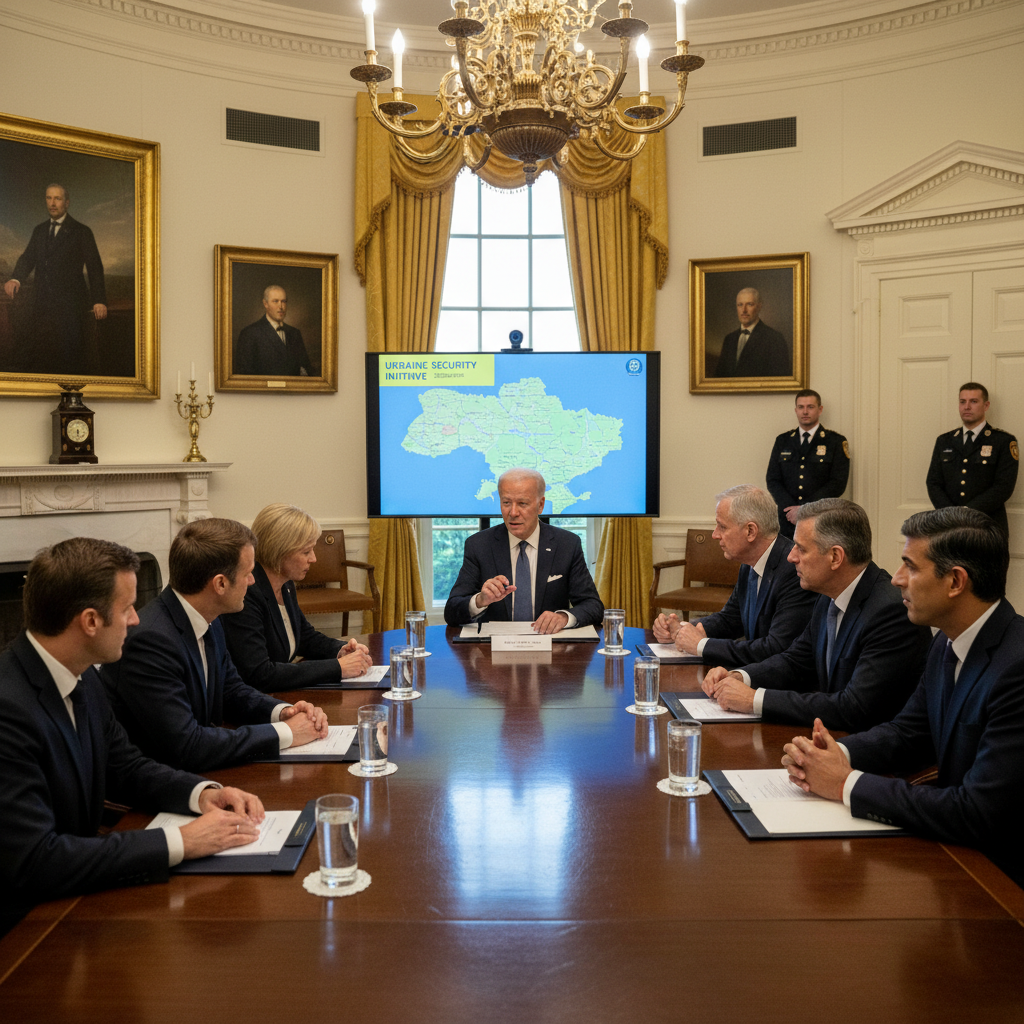
Zelenskyy, Trump, and European leaders held a joint press conference at the White House on Monday afternoon. When it came to his turn to speak, Zelenskyy said that security guarantees were “still at the core” of Ukraine’s survival and future independence. “The first one is security guarantees. And we are very happy with President [Trump], that all the leaders are here, and security in Ukraine depends on the United States and European countries,” Zelenskyy said. He added that he had been reassured by Washington’s willingness to send strong signals of support, which he said was “very important” for Ukraine. He did not elaborate on what such security guarantees might entail.
Trump also focused on the issue of security, but stressed that Europe should be shouldering the majority of the burden. He said that the war could not be resolved without “tough talks” about the territorial dimensions of a potential peace agreement. “We’re going to help them, and we’re going to make it very secure,” Trump said. “We also need to discuss the possible exchanges of territory, taking into consideration the current line of contact. That means the war zone, the war line center.”
The White House meeting was largely an acknowledgment of the sharp differences between Western leaders over the strategy of balancing support for Ukraine with an effort to nudge Kyiv toward a negotiated peace. Trump, for his part, has repeatedly shown a greater willingness to accept territorial concessions than Zelenskyy, who has insisted on preserving the integrity of Ukraine’s sovereignty and international borders at all costs.
While Trump met with Zelenskyy and European leaders in Washington, D.C., to discuss guarantees, U.S. lawmakers were sharpening their calls for economic pressure against Russia and its trading partners. Senator Lindsey Graham, R-S.C., said on Sunday that the Trump administration should move to punish countries that continue to purchase Russian oil. He said he was co-sponsoring a bill that would authorize Trump to impose punitive tariffs of up to 500 percent on nations that continued to do business with Moscow.
“My advice to President Trump and [Secretary of State Marco Rubio] is, you’ve got to convince Putin that if this war doesn’t end justly and honorably with Ukraine making concessions also, we’re going to destroy the Russian economy,” Graham said on Fox News on Sunday. The South Carolina senator, who has frequently visited Ukraine, added that China, in particular, was the most powerful country that could influence Putin’s thinking. “The second most important person on the planet to end this war is President Xi in China,” Graham said.
Trump has already indicated he was open to the use of tariffs. In August, he announced he was instituting a 50 percent tariff on India, in part for its purchases of Russian oil. Graham suggested on Sunday that China could be similarly deterred if threatened with the same action.
EUROPEAN UNION TO ANNOUNCE 19TH ROUND OF SANCTIONS AGAINST RUSSIA
In Europe, the European Union is working on its 19th round of sanctions against Russia. The latest package, expected later this month, would impose more economic pressure on Russia’s energy revenues, access to financial markets, and military-industrial base. They would also aim to close existing gaps that allow sanctioned parties to evade the costs of Western measures. It is the latest in nearly four years of coordinated Western sanctions that have left Russia the most sanctioned country in the world, more isolated economically than Iran, North Korea, and Venezuela.
CEASEFIRE?
European leaders also pushed Trump on the need for a ceasefire before there could be meaningful negotiations. German Chancellor Friedrich Merz said on Sunday that there needed to be at least a temporary cessation of hostilities to allow peace talks to have some credibility. “I can’t imagine that the next meeting would take place without a ceasefire,” Merz said. Trump demurred, noting that he had secured six peace agreements in the past few months, many of them without a ceasefire. “You have a ceasefire, and they rebuild and rebuild and rebuild,” Trump said. The only obvious advantage of a ceasefire, he said, was that it would immediately halt civilian casualties.
Alexander Stubb, who took office in March 2024, was also present in Washington on Monday for the talks at the White House. He has been skeptical of Russian President Vladimir Putin’s willingness to respect a ceasefire and emphasized Finland’s own experience with Russia, including the country’s 800-mile-long border. Stubb, who Trump has described as his “personal friend in Finland,” said that Finland and Ukraine had a “good relationship,” and that “Finland does not hold any grudges towards Ukraine.” Stubb, one of Trump’s closest interlocutors among European leaders, said that Finland had lived in peace with Russia since World War II. “If I look at the silver lining of where we stand right now, we found a solution in 1944, and I’m sure that we’ll be able to find a solution in 2025 to end Russia’s war of aggression,” he said.
The juxtaposition of Zelenskyy’s request for long-term Western guarantees for Ukraine’s security and Trump’s calls for concessions from Kyiv highlights the deep divisions in Washington and Europe over how to end the war. While there are new sanctions on the way in Europe, new tariff threats, and no sign of a ceasefire, the battlefield remains the most active as it has been in months.