
- calendar_today August 10, 2025
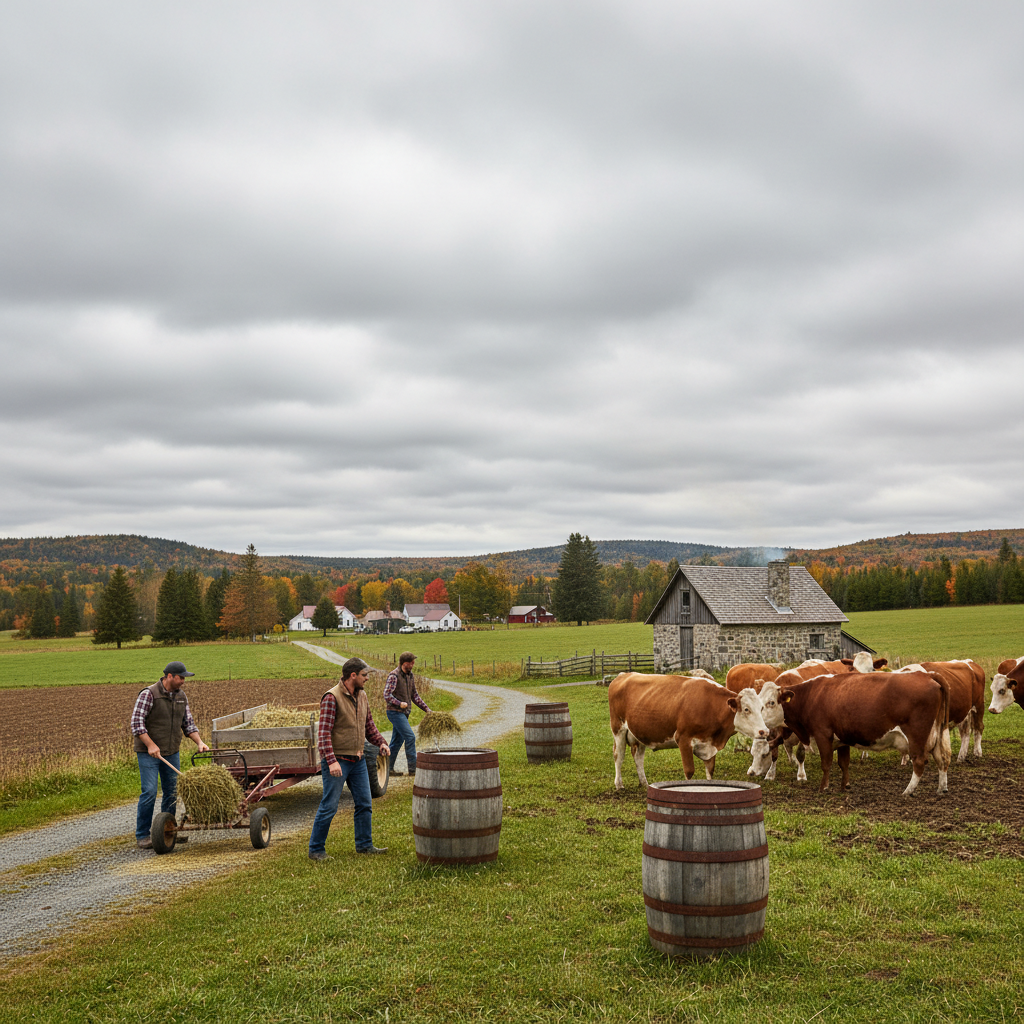
For Quebec’s farming communities, 2025 has proven to be a test of flexibility and resilience. The United States’ 25% tariff on Canadian agricultural imports has had a disproportionate effect on several of the province’s hallmark products—including dairy, pork, and maple syrup.
In regions such as Montérégie and Centre-du-Québec, pork producers are particularly feeling the sting. The U.S. market has historically accounted for more than 40% of their export volume, and current policy changes are forcing companies to search for alternative buyers in Asia and the Middle East.
Meanwhile, Quebec’s dairy sector, already navigating strict supply management rules, is facing cost spikes for feed and packaging materials—many of which are imported and also subject to new levies. The Fédération des producteurs de lait du Québec has called for increased government assistance and strategic investment in domestic processing infrastructure.
To help weather the storm, the Quebec government has announced a $250 million transition fund to assist farmers in finding new markets, streamlining operations, and building more value-added production capacity inside the province.
Tourism: Strong Local Travel, Cautious Global Outlook
Tourism, one of Quebec’s most visible economic engines, remains a vital source of income and employment. In 2024, the sector generated over $16 billion in direct spending, and 2025 is on pace to surpass that, particularly in domestic tourism.
Montreal, Quebec City, and Charlevoix are leading destinations. Events such as the Montreal International Jazz Festival and Quebec Winter Carnival have seen record domestic turnout, buoyed by the depreciation of the Canadian dollar, which makes local vacations more attractive for Canadians.
But international travel tells a more complex story. Arrivals from the United States and Europe are down 6.5% from 2019 levels, primarily due to inflation, currency fluctuations, and reduced consumer confidence in long-haul travel. Quebec’s tourism operators are reporting booking softness from European tour groups and a slowdown in cross-border day trips.
In response, the Ministry of Tourism has expanded promotional campaigns to emerging markets, including Brazil, South Korea, and the Gulf states. The government also allocated $45 million to regional tourism boards to modernize attractions, improve visitor experiences, and enhance multilingual service offerings.
Technology: Scaling Innovation Amid Global Uncertainty
Montreal’s status as a North American tech hub continues to grow, especially in artificial intelligence, clean energy, and life sciences. But in 2025, global trade friction is forcing tech firms across Quebec to adjust their operational strategies.
Tariffs on semiconductors, circuit boards, and lithium-ion components have caused project delays and cost overruns for manufacturers in Longueuil and Laval. Companies that rely on Asian imports for hardware assembly are facing 8–12% increases in supply chain costs compared to the previous year.
In response, Quebec’s Economic Development Ministry has expanded its “Fabriqué au Québec” innovation grant program, offering funding to startups that develop in-province alternatives to imported tech inputs. Universities are also receiving increased funding to boost collaboration between research labs and commercial partners, particularly in materials science and agri-tech.
Meanwhile, the province’s tech sector is capitalizing on cloud-based and AI-driven services—products that are less dependent on physical hardware and global shipping networks. Exporters of software services and game development, for instance, are seeing steady demand growth in U.S. and European markets.
Economic Outlook: Moderate Growth with a Focus on Self-Reliance
Quebec’s economy is forecast to grow 1.1% in 2025, a modest pace reflective of the broader Canadian economic environment. The province’s unemployment rate is expected to hover around 5.8% by year’s end—slightly above last year but still within historical norms.
In light of ongoing global trade tensions, the Quebec government is doubling down on policies that promote local manufacturing, cross-sector innovation, and diversification of export partners. New bilateral talks with EU and Asia-Pacific countries aim to secure alternative trade pathways for both agriculture and tech industries.
At the core of these strategies is a long-term emphasis on economic self-sufficiency. By building stronger supply chains within Quebec and lessening dependence on traditional U.S. markets, provincial leaders hope to establish a more durable foundation for growth.
“The challenge is real,” said an analyst at the Institut du Québec. “But it’s also a moment of transformation. This isn’t just about bouncing back—it’s about evolving our economic DNA.”