- calendar_today August 15, 2025
Species at 30: A Masterclass in Wasted Potential
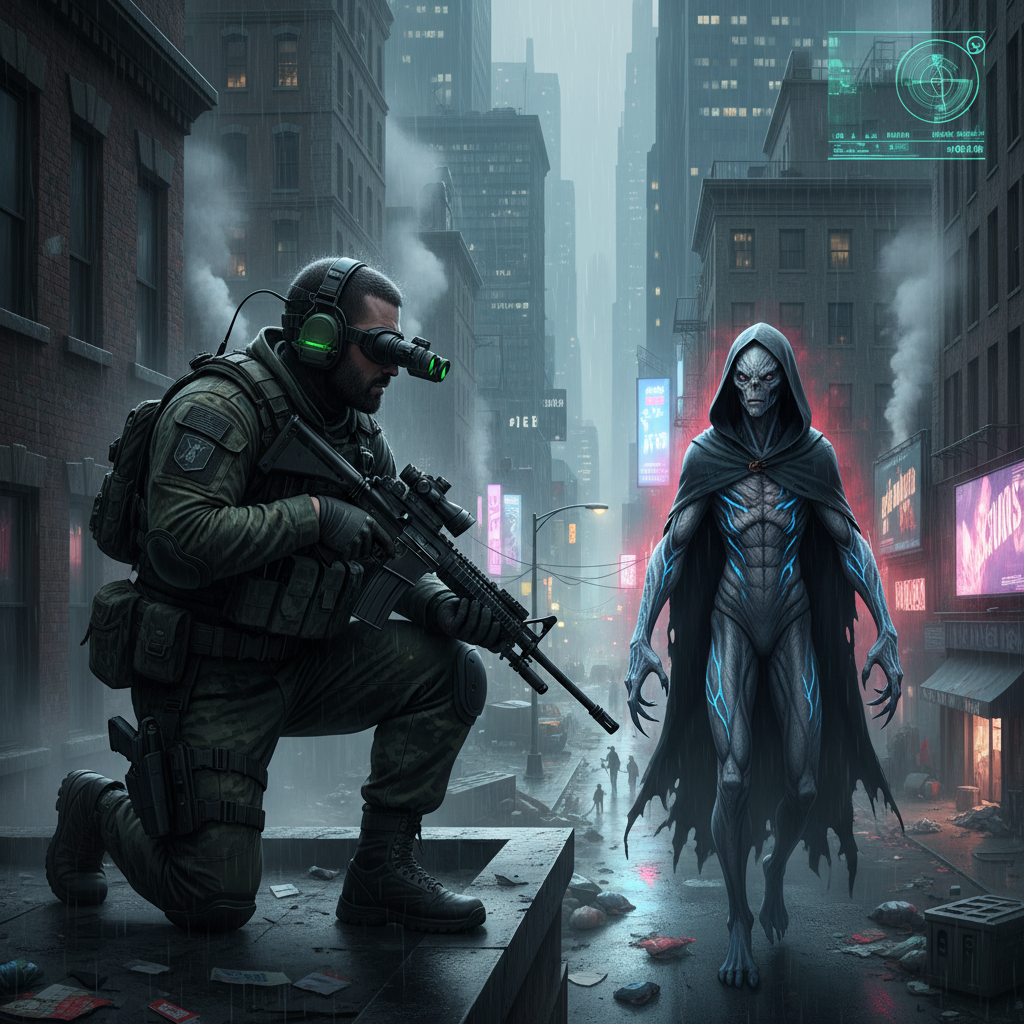
Hollywood lost a distinctive talent earlier this month when actor Michael Madsen passed away. He made his mark as a rugged character actor in tough, cult-classic films like Reservoir Dogs, Kill Bill, and Donnie Brasco. But of all of Madsen’s film roles, one has yet to be counted as part of the pantheon: his appearance as a black ops mercenary hunting a deadly hybrid of human and extraterrestrial DNA in the 1995 action/sci-fi/horror film Species. The movie, which hits its 30-year milestone this year, is a B-level relic from a time of monster movies and millennial alien paranoia.
Directed by No Way Out and Bounty helmer Roger Donaldson, Species was a weird mix of supernatural chiller, slasher flick, and low-key science fiction. The film opens with the U.S. government receiving two transmissions from deep space: the first contains a schematic for a never-before-seen fuel source, while the second provides explicit instructions on how to splice alien DNA with human DNA. Predictably, the government takes the bait. With the help of Dr. Xavier Fitch (Ben Kingsley), the hybrid is successfully created: Sil, a woman in her young adult years, played by Michelle Williams in her early days as a child actress. The experiment was designed to create a controllable hybrid organism, but the results are quite different than expected.
Sil matures rapidly, and within three months of her creation, she looks and acts like a 12-year-old. But there are problems. She experiences violent nightmares, and other signs begin to point to Sil not being as “controllable” as Fitch expected. When Fitch decides to end the experiment by pumping cyanide into her cell, Sil manages to escape—kicking off the narrative.
To find her, Fitch rounds up a team of specialists, including Madsen’s Preston Lennox, a black-ops mercenary with a no-nonsense attitude; Dr. Laura Baker (Marg Helgenberger), a molecular biologist; Dr. Stephen Arden (Alfred Molina), an anthropologist; and Dan Smithson (Forest Whitaker), a tall, dark, and enigmatic empath with the ability to feel Sil’s emotions. They follow her trail from one end of the country to the other and eventually to Los Angeles, where Sil has transformed into her adult form and is played by Natasha Henstridge. There, she goes on the hunt to find a mate and reproduce. Sil is clever and adaptable, and as the body count grows (including a train bum, a nightclub hookup, and later a romantic partner), the team of specialists must race against time to contain her before her offspring can be produced. And as the science shows, that could happen fast.
Designer and Artist: A Gigeresque Guide to Species
Part of what makes Species so memorable is the creature design itself, created by one of the most influential surrealist artists in film history: H.R. Giger. Best known for his work as the creature designer for Alien and the director of that film’s equally off-kilter sequel, Giger wanted to create a monster who was not only an “aesthetic warrior, but also sensual and deadly.” To that end, Giger’s final design was as striking as the creature’s behavior: Sil’s final form had translucent skin that Giger himself described as “like a glass body but with carbon inside.” Giger had originally planned on four stages of alien evolution for Sil, but production restraints forced him to scrap all but one, a cocoon used in the transformation sequence, and a large maternal alien body for the film’s finale.
In the end, Species was a moderate financial success, but Giger hated the film. In his eyes, Species cribbed way too heavily from Giger’s previous collaboration with Ridley Scott, Alien—especially the “punching tongue” (an outgrowth of Alien’s self-defense syringe) and, of course, the climactic birth of the next wave of lethal hybrids, which he felt was much too similar to the “chestburster” scene from Alien. (Giger even went on set to block the use of flame throwers to kill Sil, since the use of fire seemed to him too reminiscent of both Alien 3 and Terminator 2: Judgment Day.) Despite his misgivings, Giger’s monster design and fieldwork created an enduring image for an alien monster who was at once dangerous and erotic.
A Mixed Legacy
Species wasn’t a critical success upon release, and for good reason. Much of the dialogue is downright clunky, and many of the supporting characters are caricatures with little to no depth. Kingsley’s Fitch is as amoral as you might imagine, but Whitaker’s “empath” is all brooding and stating the obvious. Sil’s narrative presence as a character without a defined morality or ethics is tantalizing but not deeply explored. And some of the themes—bioethics, alien visitation, maternal instinct—are left as suggestions rather than being fully plumbed.
But then, for a film with a budget that would make a low-budget indie filmmaker today drool with envy, Species had a lot going for it. Feldman, the writer, was initially inspired by a 1973 article by Arthur C. Clarke, in which the famously staid sci-fi author speculated that aliens might never visit Earth because faster-than-light technology was too improbable. Instead, what if Feldman wondered, extraterrestrial intelligence reached out to Earth with plans for something artificial? Something created out of Earth DNA and designed to replicate at a faster rate than natural selection: a sentient, self-aware, invasive species.
The result was something of a cultural hybrid. A cautionary tale and a creature feature, Species never quite rose to the level of Alien or Terminator. But the film did find an audience—and for good reason. Between Henstridge’s performance as the most human of aliens, Madsen’s worn-down gruffness, and, of course, Giger’s unforgettable design, the movie has an enduring quality, a certain ’90s sci-fi curiosity worth exploring again.
And so here we are, 30 years later, on the flip side of a long-dead millennium. Species endures as a time capsule of what science fiction looked like when style was valued over substance. And of all of Michael Madsen’s film roles, it is one of the most memorable.