
- calendar_today September 1, 2025
Long connected with cars, motorcycles, and robotics, Honda is a name that now boldly enters the heavens. The company recently conducted a first successful reusable experimental rocket launch and landing. Although Honda has stayed mostly silent on its space-related aspirations since first stating them in 2021, this marks a significant change from conventional transportation to advanced aeronautical development.
The test was carried out at a Honda plant situated in Taiki Town, a seaside town on Hokkaido, Japan. Thanks to public and private sector cooperation including support from Japan’s national space agency, JAXA (Japan Aerospace Exploration Agency), Taiki, albeit small, has been rising in reputation as a “space town.” Honda’s test signals not only company progress but also a developing trend in Japan’s private sector, which fits perfectly into this expanding ecosystem.
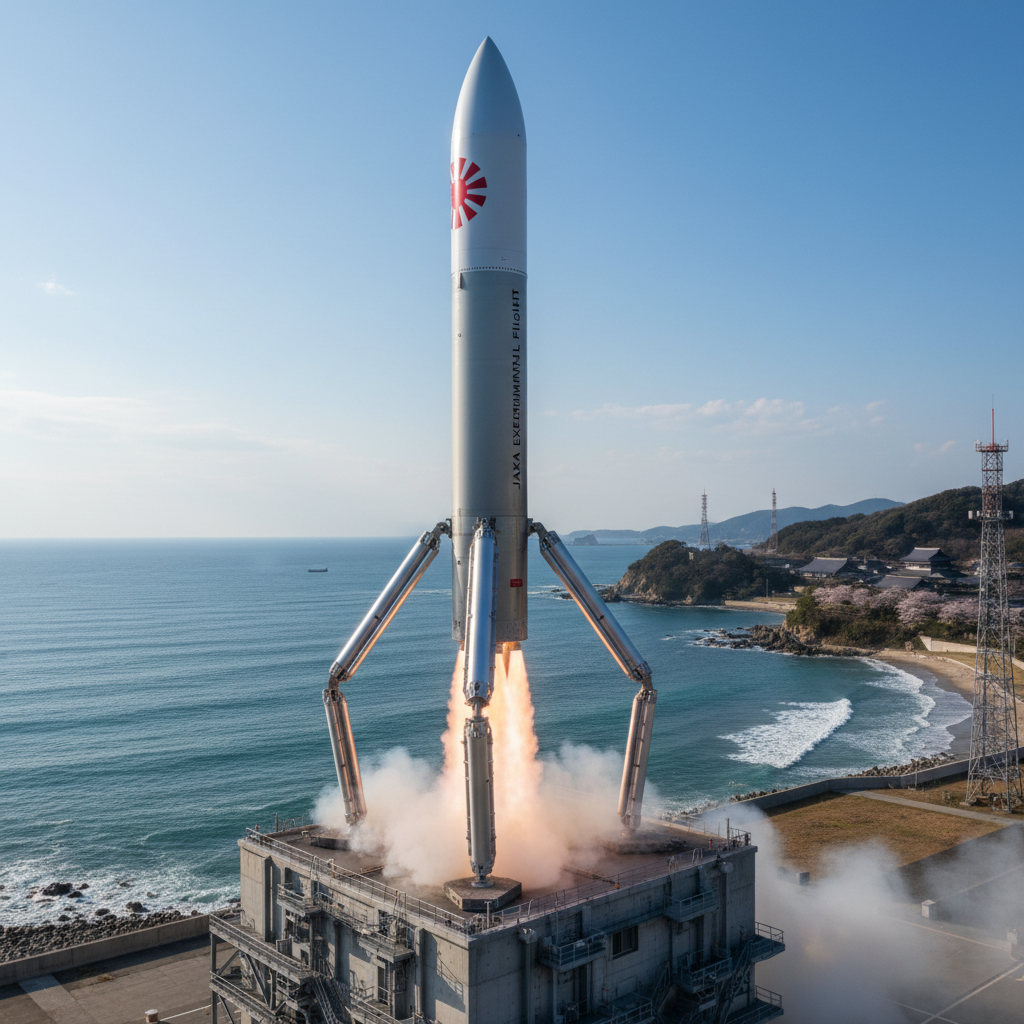
The rocket ascended to 890 feet during the test, then dropped remarkably precisely. Just under one minute, or specifically 56.6 seconds, was the overall flying time. Not the altitude or length but the landing accuracy made this test especially remarkable. The rocket touched down barely 37 centimeters from its target point. Particularly on an initial test, that degree of accuracy shows the degree of control Honda has managed to build into its system. At launch, the rocket weighed more than 2,800 pounds and rose almost 21 feet in height. Four retractable legs helped to support and steady it for takeoff and landing.
Although Honda is most known for designing vehicles that hug the road, it has cleverly used its current strengths to this aerospace project. Honda used parts from its work in automated driving systems and robotics rather than creating whole new technologies from scratch. Adapted to help control rocket flight and landing dynamics are the sensors, control software, and AI-based algorithms guiding self-driving cars. This is a special crossover of engineering disciplines illustrating how mobility technology can surpass its initial application point.
This is not only a novelty-seeking study project. By 2029 Honda wants to have suborbital launch capability. About 100 kilometers, or 62 miles, above sea level, suborbital space starts. Although a suborbital flight does not place payloads into orbit, it is nevertheless regarded as a significant turning point in space development since it provides actual experience with propulsion, flight stability, and environmental challenges outside Earth’s atmosphere. Should it be successful, Honda will be among the few businesses able to enter near-space, a major step forward for a company still in its early years of aeronautical development.
Honda’s rocket program is still primarily in the basic research stage at this point. Regarding commercialization, no official decisions have been taken; the company has not stated if it will join the cutthroat private launch market. Still, a company like Honda has obvious reasons for looking at this area. Having in-house access to space-based infrastructure could provide a strategic edge as businesses all around depend more on satellite networks for communication, navigation, mobility tracking, even vehicle-to–vehicle interaction. From global navigation systems to connected car ecosystems to logistics planning, many of Honda’s long-term mobility objectives could be benefited by satellite deployment control.
The site of the test also says volumes about Japan’s changing attitude to space. Where the test was conducted, Taiki Town is gradually rising in prominence in the private space industry of Japan. Aerospace testing is perfect in this location because of its isolated topography, open airspace access, and government-sponsored development. Now that Honda is doing significant tests there, Taiki’s influence will probably become even more noticeable in the next years.
This test was a major success even though it lacked a trip to space or satellite orbital placement. Honda has demonstrated that it can design and oversee a vertically launched rocket system with great accuracy of landing. That is itself a significant technological achievement, especially for a business first entering the aerospace industry. It also signals the start of what might be a greater dedication to space that combines Honda’s vision for next-generation mobility with its automotive heritage.
Honda might still be rooted in transportation, but this launch makes it abundantly evident that the business is thinking far outside the road. Whether next launches reach the edge of space or beyond, Honda’s upward path has formally started.