
- calendar_today August 14, 2025
Nvidia’s 2025 Forecast and the AI Pulse of Quebec
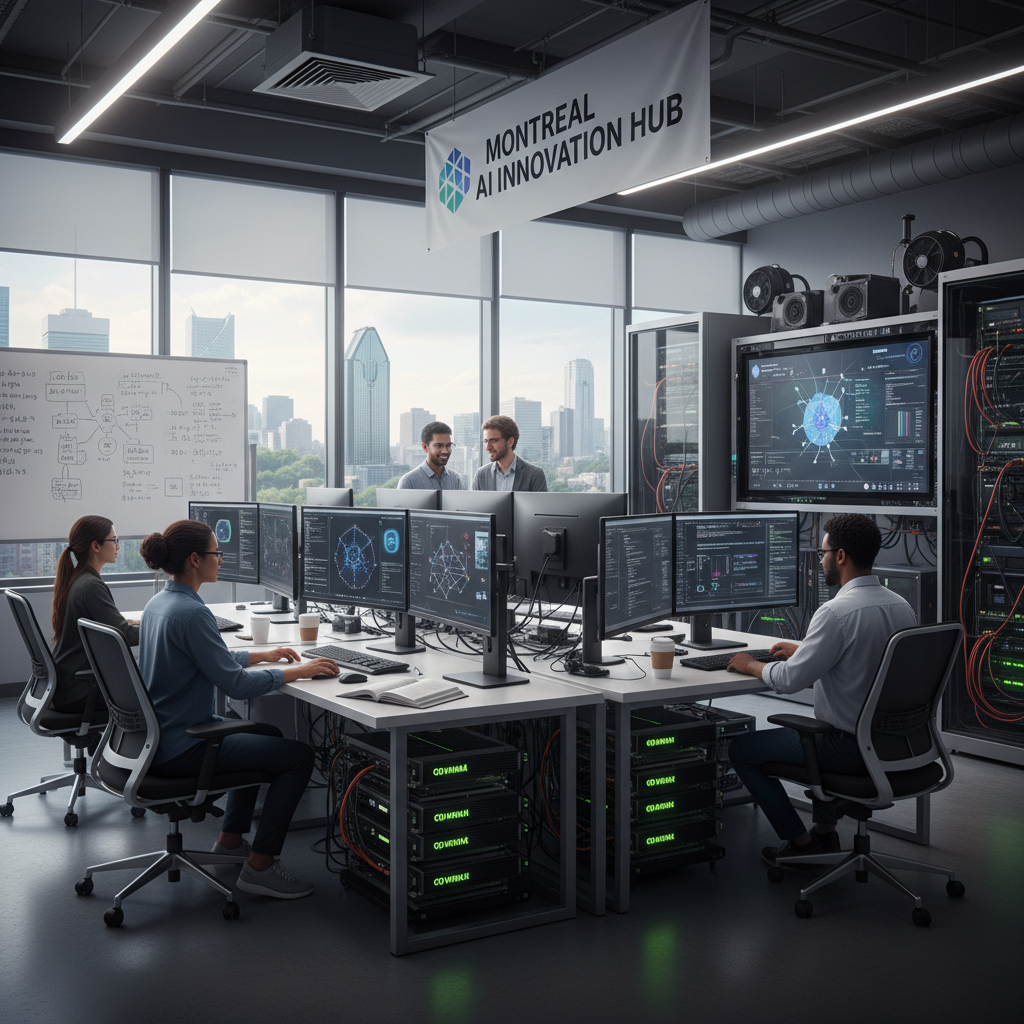
Montreal isn’t merely a Canadian success story—it’s a global AI powerhouse. With the province’s largest metropolis hosting institutions like MILA (Quebec AI Institute) and the University of Montreal, the city has become a magnet for Nvidia-powered deep learning research.
The 2025 Nvidia stock price target of $200 per share, driven by surging demand for GPUs in AI infrastructure, reflects a broader shift Quebec is poised to benefit from—if it plays its cards right. MILA, home to luminary Yoshua Bengio, has relied heavily on Nvidia’s GPU platforms to train some of the earliest generative models and now partners with international labs on climate, biotech, and multilingual NLP models.
But as capital and talent pour into North America’s AI capitals, will Quebec’s policies help it grow—or hold it back?
Francophone Innovation Meets Global Tech
In Quebec, language isn’t just culture—it’s policy. While Nvidia’s ecosystem primarily develops in English, Quebec’s strict language laws (notably Bill 96) have created friction with multinational AI firms hoping to expand within Montreal.
Startups using Nvidia infrastructure must localize interfaces, documentation, and employee communication—sometimes at the expense of speed and agility. For smaller AI startups or foreign investors, this presents a decision point: is the linguistic friction worth the innovation upside?
Yet, for local entrepreneurs, the policy acts as a moat. “We are building in a bilingual market, for bilingual users,” said Véronique Lemoine, co-founder of a Montreal-based AI healthtech startup. “That’s a competitive advantage when scaling in European and African Francophone markets.”
Nvidia’s Backbone in Quebec’s Startup Ecosystem
Montreal’s AI startup density rivals that of Toronto and San Francisco, particularly in healthtech, insurance, logistics, and creative tech. And behind many of those models? Nvidia’s CUDA platform, powering training systems for predictive analytics, synthetic data generation, and computer vision.
Startups like Element AI (acquired by ServiceNow), BioSymetrics, and Heyday have scaled solutions with Nvidia’s enterprise partnerships. In Laval and Longueuil, Nvidia-powered data centers are helping incubators and researchers access GPU computing without leaving the province.
Beyond Montreal, Quebec City is emerging as an AI logistics hub—tying together AI-based supply chain models and public-sector smart mobility projects, many of which now rely on Nvidia’s TensorRT optimization stack.
Public Funding and a Cautious Private Sector
The Quebec government has committed over $300 million to AI research and commercialization since 2018, much of it allocated to GPU clusters, data labeling, and enterprise grants. But public-sector investment hasn’t been matched by aggressive adoption in traditional industries.
In Quebec’s sprawling manufacturing and resource sectors, AI is still seen as abstract or high-risk. Despite government incentives, adoption lags behind Ontario and Alberta in industries like mining, energy, and agriculture—sectors where Nvidia tools could optimize productivity and reduce environmental impact.
One Laval-based AI consultancy reported that 70% of its clients still run on CPU-based systems, citing costs and staff training as key deterrents.
Talent Magnet—and the Risk of Brain Drain
With deep academic roots and affordability compared to Toronto or Vancouver, Quebec attracts AI talent from Latin America, Europe, and Asia. The province’s French-language edge makes it especially appealing for Francophone AI researchers, who face fewer language barriers in work and life.
However, with Nvidia’s 2025 momentum expected to trigger major expansions in the U.S., many graduates of Polytechnique Montréal, McGill, and HEC are being lured across the border with six-figure offers.
In response, MILA and McGill are pushing for more public-private Nvidia partnerships to keep innovation and opportunity grounded in Quebec. “We need homegrown pathways, not just exports,” says Dr. Ali Ben Ayed, who mentors startups at Montreal InVivo.
Can Quebec Translate AI Theory Into Economic Power?
With Nvidia climbing to a forecasted $200 share price by 2025, Quebec is at a crossroads. It leads Canada in AI theory, open-source research, and ethics—but commercial scalability remains a challenge.
From local chip adoption and language compliance to matching U.S. talent incentives, Quebec’s future in the AI boom depends on swift, targeted policy and a unified ecosystem.
Because if Nvidia’s value reflects global AI urgency, Quebec has the intellect—but needs to accelerate its execution.