
- calendar_today August 14, 2025
.
Electric Vehicle adoption is back under fire in the United States as sales start to falter and home charging options are found to be more limited than expected. After more than a year of consistent month-on-month growth in EV sales, the first double-digit percentage declines are starting to appear in data. Brands like Genesis and Volvo have already seen customers walk away from their electric cars, leading to the elimination of electric lineups at both brands.
The regulatory environment is also making things difficult. The Biden administration has curtailed EV subsidies and retracted vehicle pollution rules, leaving the federal government with little incentives for customers. According to new research, the larger issue could come from vehicle owners themselves.
Charging Could Be Easier Than It Seemed
For years, surveys and studies have reported concerns about charging as the number one challenge to EV adoption. New research from Telemetry Vice President Sam Abuelsamid takes a closer look at the EV charging landscape and finds that a factor which often goes unconsidered might be the one issue more.
Fast-charging infrastructure is a frequent subject of discussion in the press, but the majority of EV charging takes place at home. Nearly 80 percent of EV charging is now estimated to occur using AC power, most often at a single-family residence. According to data from the National Renewable Energy Laboratory (NREL), 42 percent of American homeowners already park near a charging outlet with the capacity to support level 2 (240-volt) charging.
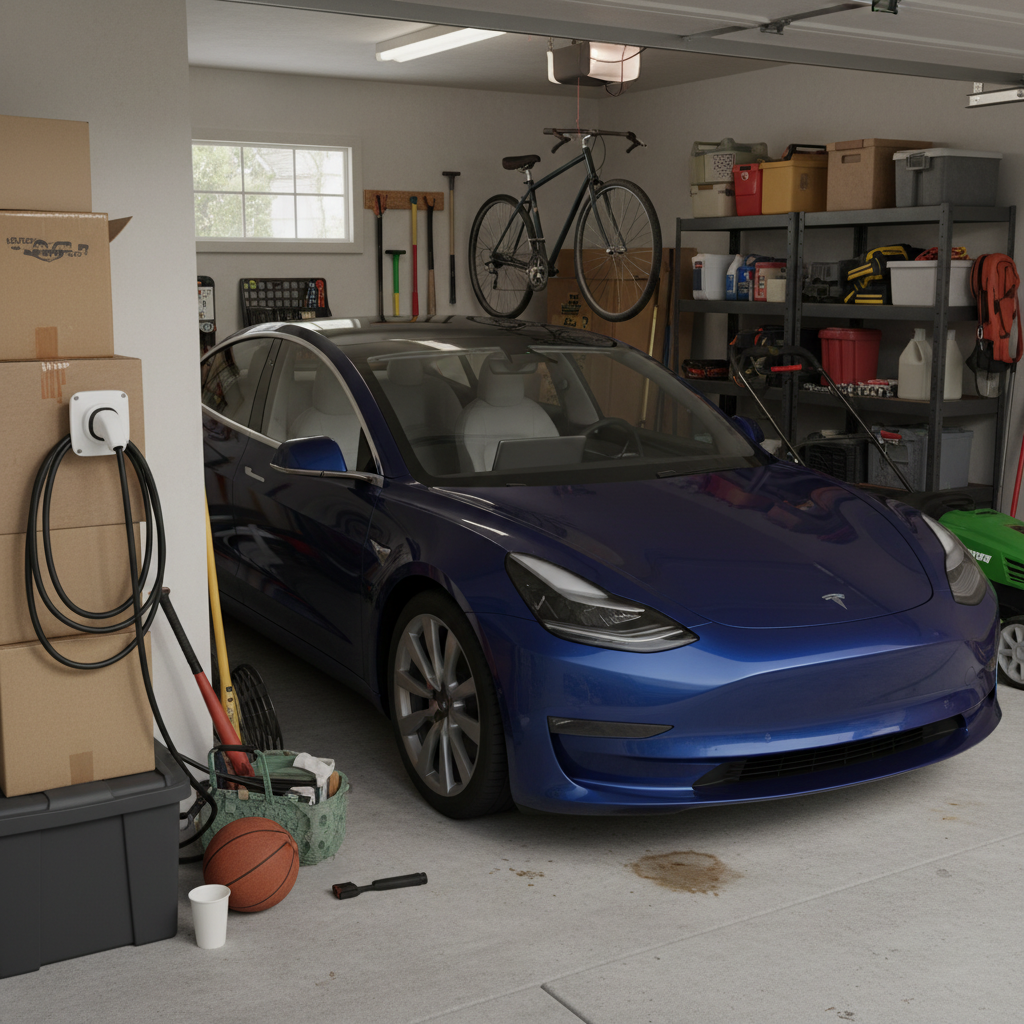
That share could increase significantly, up to 68 percent, if owners opened up space in their garages and changed their parking habits. “90 percent of all houses can add a 240 V outlet near where cars could be parked. Parking behavior, namely whether homeowners use a private garage for parking or storage, will likely become a key factor in EV adoption,” Abuelsamid says.
Parking vehicles in garages, as opposed to leaving the space for other uses, would increase the number of homes capable of EV charging from 31 million to over 50 million. Including homes where wiring new outlets is possible, this share could top 72 million homes. The total far outpaces even Telemetry’s most bullish forecast for EV market penetration in 2035, estimated at between 33 million and 57 million vehicles.
The number of homes capable of charging on paper does not always indicate who is prepared to actually do so. The same NREL study indicated that almost 34 million homes would need major electrical upgrades to support a level 2 charger. This equipment, capable of at least 30 amps of power, typically requires new wiring and can demand the replacement of the entire electrical panel. These upgrades can run thousands of dollars and undermine one of EVs’ chief financial advantages over gas vehicles.
Multifamily Housing Adoption Problems
Homeowners’ difficulties could pale in comparison to the adoption rate in multifamily homes, which account for 23 percent of all U.S. households. These residences include apartment buildings, condos, townhomes, co-ops, and others. Unlike owners, individual EV owners in multifamily buildings have limited control over charger installation.
Typically, renters must either convince a landlord, property management firm, or cooperative board to install chargers. These groups have a history of resistance to such efforts. The financial barrier to adoption in multifamily residences is also higher. Installing even a set of two shared level 2 chargers in a co-op may first require a complete electrical panel upgrade. This process, which can cost millions of dollars in large buildings, is just the beginning. Wiring may need to be run to distant parking spots, further increasing the cost and complexity of installation. Unlike their counterparts in single-family homes, apartment renters are typically ineligible for utility or local government subsidies for charger installation.
Today, some 1 million EV owners live in multifamily housing, and only 11 percent are parked close enough to a charging outlet to recharge at home. The number could expand if regulators keep to plans to mandate between 20 and 25 percent of charging-ready parking spaces in new construction, but even these measures would still fall short of demand. Telemetry estimates a total of just 6.7 million to 11.4 million charging-capable spaces in multifamily dwellings by 2035, far below the number of expected buyers.
Public Charging Infrastructure Woes
With so many expected multifamily residents unable to charge at home, public charging will become increasingly critical. Telemetry expects as many as 11.7 million to 14.3 million EV drivers who own homes to still rely on public charging by 2035. Another 7.8 million to 8.1 million EV owners will also still live in multifamily residences and will need public chargers.
Meeting that demand will require between 523,000 and 586,000 DC fast chargers, but the public charging landscape has its own set of challenges. While DC fast charger deployment is underway, power companies are already struggling to meet demand from data center projects powered by AI, complicating new large-scale charging sites’ plans for generation and distribution capacity.
EV adoption is by no means a foregone conclusion in the U.S. While an estimated 72 million households could, in theory, support EV charging, the realities of garage clutter, high electrical upgrade costs, and multifamily adoption hurdles could slow the pace of conversion. Even with strong public charging expansion, demand could outstrip supply in the decade ahead. For the time being, the future of electric vehicles in the U.S. may depend as much on what homeowners store in their garages as it does on government policy or automakers’ plans.