
- calendar_today August 20, 2025
A new artificial intelligence model from Carnegie Mellon University called LegoGPT translates simple textual descriptions into physically stable Lego structures. The innovative system stands out because it not only creates Lego designs that match the input text but also guarantees that these designs can be constructed in reality by humans or robots. LegoGPT operates on the essential ability to understand descriptive text commands like “a streamlined, elongated vessel” or “a classic-style car with a prominent front grille” and turn them into accurate Lego brick arrangements, which produce a stable object.
The training of an autoregressive large language model on a comprehensive dataset containing more than 47,000 stable Lego designs, which have been given descriptive captions by OpenAI’s GPT-4o, enables this achievement. The training process teaches the AI system about how language correlates with stable Lego arrangements so it can predict the next brick needed to maintain structural stability in a sequence. LegoGPT uses foundational principles from large language models like ChatGPT but shifts its prediction focus from generating the next word to determining the next brick. Researchers achieved this result by fine-tuning Meta’s instruction-following language model LLaMA-3.2-1B-Instruct and incorporating a software tool that uses mathematical models to simulate gravitational forces and structural stability for design verification. LegoGPT’s “physics-aware rollback” mechanism identifies structural weaknesses during the design process by backtracking to try alternative brick placements and iteratively refines the design to increase final output stability from 24 percent to 98.8 percent.
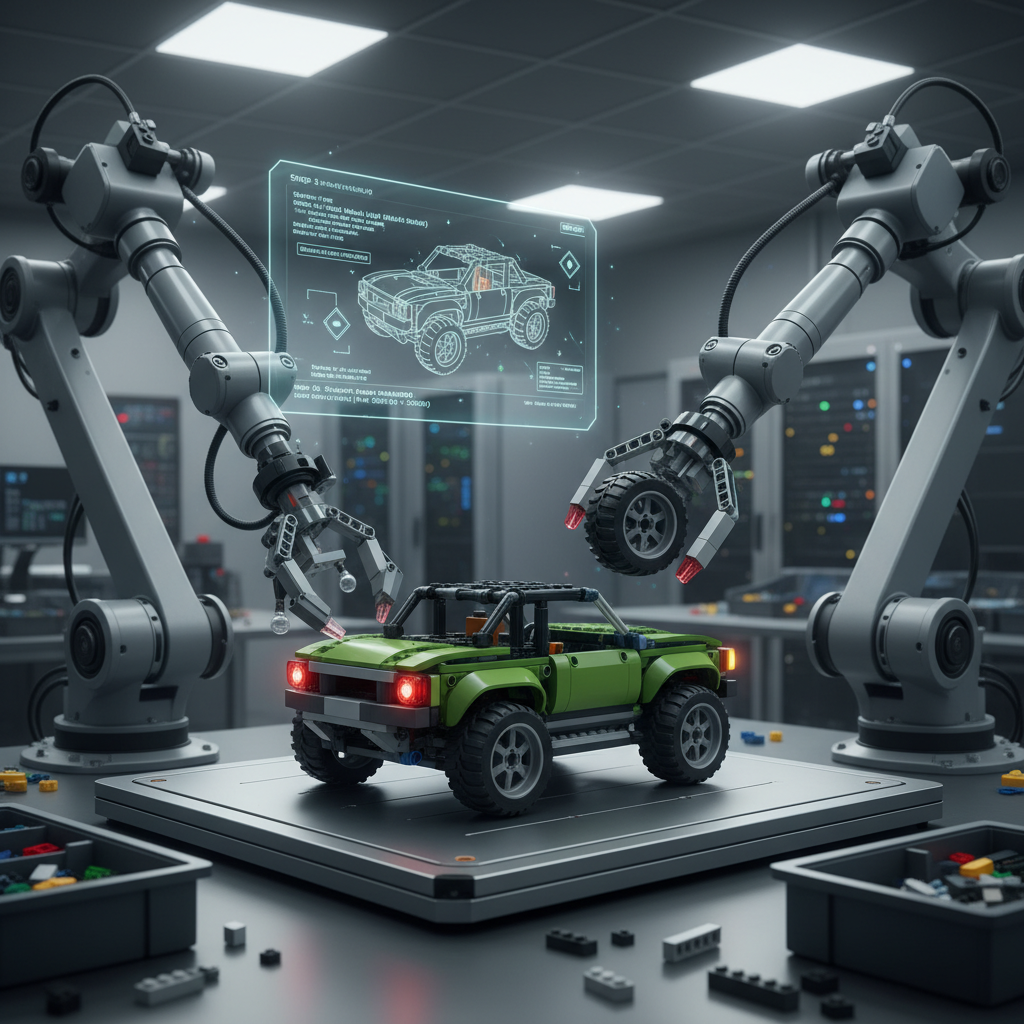
The researchers performed thorough tests with robots and people to confirm that LegoGPT’s designs work in real-world applications. The researchers used an advanced dual-robot arm system with force sensors to precisely assemble AI-created models following specific brick sequences. Human testers engaged in evaluating AI-designed builds through manual assembly demonstrated the physical buildability and stability of LegoGPT-generated structures, which matched the original textual descriptions. The experiments proved that the system can convert written instructions into physical Lego models that match the described designs and maintain the structural strength needed for assembly outside of a digital context. The fact that both robots and humans can successfully build the structures demonstrates how practical and robust the AI-generated building instructions are.
In comparison to other AI models for 3D creation, such as LLaMA-Mesh, LegoGPT stands out because it maintains a strict dedication to structural integrity. The team’s assessments showed their method produced many more stable structures than alternative approaches, which typically emphasize visual detail above physical stability. LegoGPT functions solely within a restricted 20×20×20 building space and uses a constrained selection of eight conventional Lego brick types. The research group recognizes these constraints and detailed their future development plans to broaden the system’s capacity for larger and more intricate designs by incorporating a diverse range of brick types, such as slopes and tiles. The enhancement of LegoGPT will probably necessitate additional improvements to both the AI model and its physics simulation framework due to the increased complexity.
By combining language understanding with physics simulation, LegoGPT demonstrates a major advancement in AI-driven physical construction design. The methodologies and principles developed for LegoGPT during its application to toy design demonstrate significant potential applications in architecture and engineering beyond its original scope. AI design tools can now convert textual abstract instructions to physical structures, which prioritize stability and buildability, thus creating practical solutions for tangible object production. The progression of AI systems exemplified by LegoGPT will enable intuitive and efficient design and fabrication processes in multiple industries, which will democratize complex physical structure creation.